Upgrading an electrical panel to incorporate comprehensive energy monitoring is a vital step toward reducing operational costs and managing peak demand. However, when dealing with legacy distribution boards across commercial or industrial facilities, space constraints and the threat of unscheduled facility downtime create significant engineering bottlenecks.
For decades, standard current transformers were the default option for current tracking. Today, electrical contractors and systems integrators face a distinct choice when modernising electrical panel frameworks: rogowski coil vs ct (specifically, the highly popular split-core current transformer).
Choosing the incorrect sensor can result in blown project timelines, reading inaccuracies, or physical fitment failures inside tight enclosures. To ensure long-term stability for your split core ct or flexible loop installation, you must balance mechanical installation realities against electrical accuracy profiles.
Understanding the Contenders: Physics and Mechanics
To make an informed decision for your power tracking project, it is essential to look at how both technologies function and how they differ mechanically.
The Split-Core Current Transformer (CT)
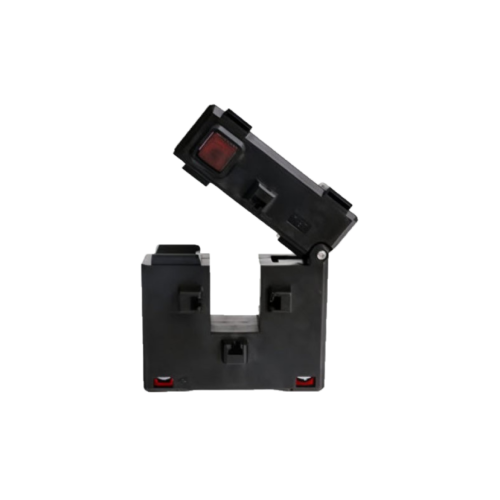
A standard split core ct operates on traditional electromagnetic induction principles. It features a split ferrosilicon or mu-metal magnetic core wrapped in a secondary copper winding. The casing can be unlatched, placed around an existing primary conductor, and snapped shut.
Because it utilises a magnetic core, the secondary output is typically a scaled current (such as 1A or 5A AC) or a safe, low-voltage millivolt loop (0-333mV). The core must close completely; any air gap in the interlocking magnetic path will severely degrade measurement accuracy and induce severe phase-angle errors.
The Flexible Rogowski Coil
A Rogowski coil replaces the heavy iron or steel core with a non-magnetic air core. It consists of a precisely wound toroidal coil encapsulated in a flexible, rope-like thermoplastic sleeve. The loop can be unlinked at one end, threaded around an irregular busbar or tight cable bundle, and clipped back together.
Because there is no magnetic material, the raw output voltage is a low-amplitude AC millivolt signal proportional to the rate of change (di/dt) of the primary current. This output requires an external integration circuit to shift the phase back by 90° and standardise the signal before it can pass to a sub-meter.
Engineering Comparison Matrix
Evaluating a rogowski coil vs ct requires an analysis of electrical constraints, material weight, and physical installation pathways:
Engineering Parameter | Split-Core Current Transformer | Flexible Rogowski Coil |
Magnetic Saturation | Yes (Core saturates at high Amps) | No (Air core cannot saturate) |
Physical Footprint | Bulky, rigid, square housing | Slim, flexible, lightweight rope |
Dynamic Amp Range | Narrow (Optimised for fixed range) | Extremely Broad (10A to 50kA+) |
Weight & Safety | Heavy; open secondary risk | Light; safe millivolt output |
Measurement Accuracy | Class 0.5 to Class 1.0 | Class 0.5 to Class 1.0 (With Kit) |
Key Decision Factors for Switchboard Retrofits
- Overcoming Spatial and Weight Bottlenecks
In old or highly dense distribution boards, conductors are frequently packed tightly together with mere millimetres of clearance between phases. Trying to mount three rigid, heavy split-core CTs onto crowded three-phase busbars can be a physical impossibility.
A flexible coil has a cross-sectional diameter of often less than 10mm, allowing it to slide easily behind obstructions and twist around irregular conductors where square plastic housings cannot fit. Furthermore, a large split-core CT rated for 2000A can weigh several kilograms, putting mechanical stress on copper bars; a flexible loop weighs only a few grams.
- Managing Dynamic Load Profiles and Saturation
Iron-core transformers are limited by the physical laws of magnetism. If the primary current surges past the rated capacity of the CT, the magnetic core experiences saturation. This distorts the secondary waveform, flattening the peaks and leading to massive measurement errors during peak demand events or harmonic spikes.
Because Rogowski coils use an air core, their linearity is absolute across a massive dynamic range. A single coil can track a baseline facility load of 20A over the weekend and seamlessly monitor a 4000A manufacturing surge on Monday morning without experiencing saturation or accuracy degradation.
- Safety and Open-Circuit Hazards
Traditional current transformers with 5A or 1A secondary loops present a significant safety hazard if they are disconnected while the primary conductor is live. An open-circuit secondary loop will generate dangerous high-voltage spikes across the open terminals, threatening to destroy the meter or cause arcing and severe injury to electrical personnel.
Rogowski coils and millivolt-output split-core units are intrinsically safe. Because their secondary output loops operate on low-voltage millivolt signals, an open-circuit fault will not produce dangerous high-voltage transients inside the control cabinet.
The Final Verdict: Which Fits Your Framework?
- Choose a Split-Core CT If: You are monitoring smaller, lower-amperage sub-circuits (typically under 400A), have sufficient physical clearance on individual insulated cables, and want a simple, direct connection to an existing power meter without adding external integration modules to the DIN rail.
- Choose a Flexible Rogowski Coil If: You are retrofitting large three-phase incoming main supplies or complex busbar geometries, dealing with space-constrained enclosures, managing high or unpredictable dynamic current thresholds (up to several thousand amps), and require a lightweight solution that completely eliminates magnetic saturation risks.
Ready to finalise your panel monitoring hardware selection? Reach out to the experts at ION Technology Group today!